
UML: use case diagram and sequence diagram
Completion requirements
 Sequence diagram
Opened: Sunday, 5 May 2019, 12:00 AM
Due: Sunday, 5 May 2019, 12:00 AM
Use case diagram
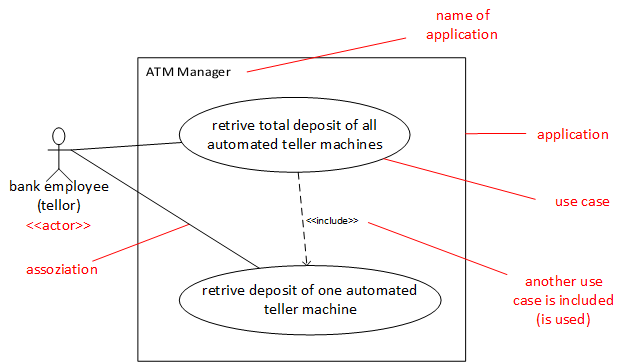
This type of diagram can be used to easily show who can do what with the software system, and which use cases are realized by the application:
 use case diagram
Along with the class and object diagram class diagram and object diagram
the following code results:
 1 public class AutomatedTellerMachine {
 2     private double moneySupply;             // encapsulated property: in all methods of class accessible
 3
 4     AutomatedTellerMachine(float moneySupply) {
 5         this.moneySupply = moneySupply;
 6     }
 7
 8     public double getMoneySupply() {
 9         return moneySupply;
10     }
11 }
 1 import java.util.ArrayList;
 2 import java.util.Collection;
 3
 4 public class Bank {
 5     private double totalMoneySupply;
 6     private Collection<AutomatedTellerMachine> automatedTellerMachines = new ArrayList<>();   // Bank has * atm's
 7
 8     public Bank(Collection<AutomatedTellerMachine> automatedTellerMachines)
 9     {
10         this.automatedTellerMachines = automatedTellerMachines;
11     }
12     public double getTotalMoneySupply()
13     {
14         return totalMoneySupply;
15     }
16
17     public void sumMoneySupply()
18     {
19         totalMoneySupply = 0;
20         for (AutomatedTellerMachine automatedTellerMachine: automatedTellerMachines)       // sum money supply
21             totalMoneySupply += automatedTellerMachine.getMoneySupply();
22     }
23 }
 1 import java.util.ArrayList;
 2 import java.util.Arrays;
 3
 4 public class Main {
 5
 6     public static void main(String[] args) {
 7
 8         AutomatedTellerMachine atm1 = new AutomatedTellerMachine(12000);
 9         AutomatedTellerMachine atm2 = new AutomatedTellerMachine(8000);
10         AutomatedTellerMachine atm3 = new AutomatedTellerMachine(10000);
11
12         Bank bank1 = new Bank(new ArrayList<>(Arrays.asList(atm1, atm2, atm3)));// Creation of bank object:
13                                                                                 // a list with references to atm's is copied
14         System.out.println("Money supply of atm1: " + atm1.getMoneySupply());
15
16         bank1.sumMoneySupply();
17         System.out.println("Total money supply bank1: " + bank1.getTotalMoneySupply());
18         System.out.println(bank1.getTotalMoneySupply());
19     }
20 }
Sequence diagram
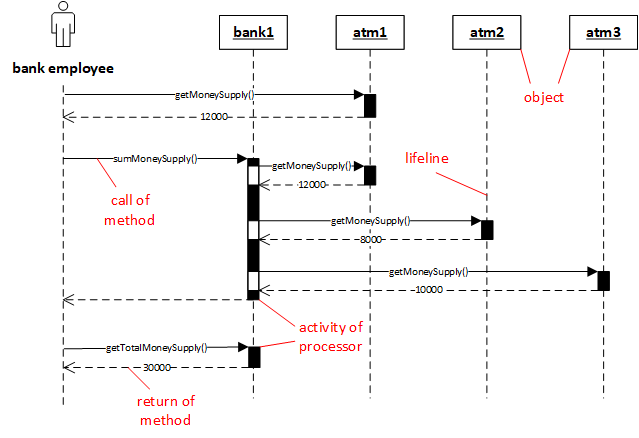
This type of UML diagram represents the interactions of the objects among themselves (ie the method calls):
Sequence diagram ________________________________________________________________________________________________________________________________________
Task:
Task: Delete the property
totalMoneySupply of the class Bank without replacement. The functionality should be preserved by the method sumMoneySupply() returns the total money supply as a return value. For this, the four UML diagrams have to be partially changed.