
Solution: Role names
Completion requirements
The UML use case diagram requires double navigation directions:
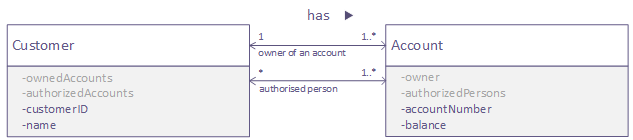
Role names with double navigation direction
 1 import java.util.ArrayList;
 2
 3 public class Account {
 4     private int accountNumber;
 5     private double balance;
 6     private Customer owner;                          // account has 1 owner
 7     private ArrayList<Customer> authorizedPersons;   // account has * authorizedPersons
 8
 9     public Account(int accountNumber, double balance)
10     {
11         this.accountNumber = accountNumber;
12         this.balance = balance;
13         authorizedPersons = new ArrayList<>();      // creation of object is still nessecary
14     }
15     public void addAuthorizedCustomer(Customer customer)
16     {
17         authorizedPersons.add(customer);
18     }
19
20     public Customer getOwner() {
21         return owner;
22     }
23     public void setOwner(Customer owner) {
24         this.owner = owner;
25     }
26     public int getAccountNumber() {
27         return accountNumber;
28     }
29
30     public ArrayList<Customer> getAuthorizedPersons() {
31         return authorizedPersons;
32     }
33 }
 1 import java.util.ArrayList;
 2
 3 public class Customer {
 4     private int CustomerID;
 5     private String Name;
 6     private ArrayList<Account> ownedAccounts;        // customer owns * accounts
 7     private ArrayList<Account> authorizedAccounts;   // customer owns * authorized accounts
 8
 9     public Customer(int nr, String name)
10     {
11         CustomerID = nr;
12         Name = name;
13         ownedAccounts = new ArrayList<Account>();
14         authorizedAccounts = new ArrayList<Account>();
15     }
16
17     public void addOwnedAccount(Account account)
18     {
19         ownedAccounts.add(account);
20         account.setOwner(this);
21     }
22     public void addAuthorizedAccount(Account account)
23     {
24         authorizedAccounts.add(account);
25         account.addAuthorizedCustomer(this);
26     }
27
28     public int getCustomerID() {
29         return CustomerID;
30     }
31     public String getName() {
32         return Name;
33     }
34     public ArrayList<Account> getOwnedAccounts() {
35         return ownedAccounts;
36     }
37     public ArrayList<Account> getAuthorizedAccounts() {
38         return authorizedAccounts;
39     }
40 }
 1 public class Main {
 2
 3     public static void main(String[] args) {
 4         Customer c1 = new Customer(1, "Owner A");
 5         Customer c2 = new Customer(2, "Authorized person B");
 6         Customer c3 = new Customer(3, "Authorized person C");
 7
 8         Account account1 = new Account(1, 50);
 9         Account account2 = new Account(2, 100);
10
11         c1.addOwnedAccount(account1);
12         c2.addAuthorizedAccount(account1);
13         c3.addAuthorizedAccount(account1);
14
15         c1.addAuthorizedAccount(account2);
16
17         // Navigation from customer to account
18         System.out.println(c1.getName() + " is owner of ");
19         for (Account account: c1.getOwnedAccounts())
20         {
21             System.out.println("account number " + account.getAccountNumber());
22         }
23         System.out.println("and an authorized person of ");
24         for (Account account: c1.getAuthorizedAccounts())
25         {
26             System.out.println("account number " + account.getAccountNumber());
27         }
28
29         // Navigation from account to customer
30         System.out.println("\nOwner of account number " + account1.getAccountNumber() + " is ");
31         System.out.println(account1.getOwner().getName() + " with customer ID " + account1.getOwner().getCustomerID());
32         System.out.println("and autorized persons are ");
33         for (Customer customer: account1.getAuthorizedPersons())
34         {
35             System.out.println(customer.getName() + " with customern ID " + customer.getCustomerID());
36         }
37     }
38 }
Last modified: Monday, 20 May 2019, 9:01 AM