
Development of research competence in the classroom
Writing competence is a key competence
If you can 'describe' a process or a thing, for example, you are making sure that you have actually understood the subject. If difficulties arise here, there are really only two possibilities:
1. not everything has been fully understood. Then you will have to do some extra work,
or
2. the linguistic or written language means to fulfil the task are lacking. In this case, the problem is more profound, as it is a lack of writing or language skills.
In both cases, a chatbot can help. In the first case, however, internet research may be the better alternative (sources, accuracy and comprehensibility of the answers, etc.). In the case of the need to improve language or writing skills, the use of chatbots is the better choice for students.
Chatbot as a learning opportunity
The use of ChatGPT, Bing Chat and chatbots in teaching offers many opportunities:
Students can use ChatGPT to have interactive conversations, practise and improve their skills and language competency as well. The chatbot provides instant feedback, allowing learners to identify and correct their mistakes.
Risk for 'bad' students
It is important to note that only experienced students can use these tools correctly. They are able to write the appropriate prompts, check the results and put them in relation to their own knowledge, as well as provide the transfair performance to improve their own language skills. The chatbot is mainly used as a source of inspiration.
With inexperienced students, on the other hand, there is a very high risk that the chatbot will simply be used for unreflected text production.
The best thing that can happen to them is that they recognize an incorrect answer as quickly as possible. This way, they will immediately realize that the chatbot cannot be trusted blindly. The machine's answers may have to be re-edited by the user.
Otherwise, the learning success even decreases because the students have to think even less or use the chatbotin a completely uncontrolled
manner.
This must be counteracted, otherwise the gap between 'good' and 'bad' students will widen even further.
Choice of social form in the classroom
It therefore often makes sense to use co-operative social forms such as group work or pair work in lessons. In this way, weaker pupils can benefit from stronger ones.
Phases of individual work are certainly also useful so that the weaker pupils are also confronted with their weaknesses. The tasks must therefore also be individualised so that everyone is appropriately challenged. A chatbot can provide the teacher with effective help here and save a lot of preparation time. In any case, the teacher should be available to provide individualised support to their students during their research.
Frontal teaching, on the other hand, should be used sparingly, as motivation, learning and gaining experience are often more effective through personal action.
Chatbot research analysis
The flowchart below compares the workflows of traditional web search and chatbot research:
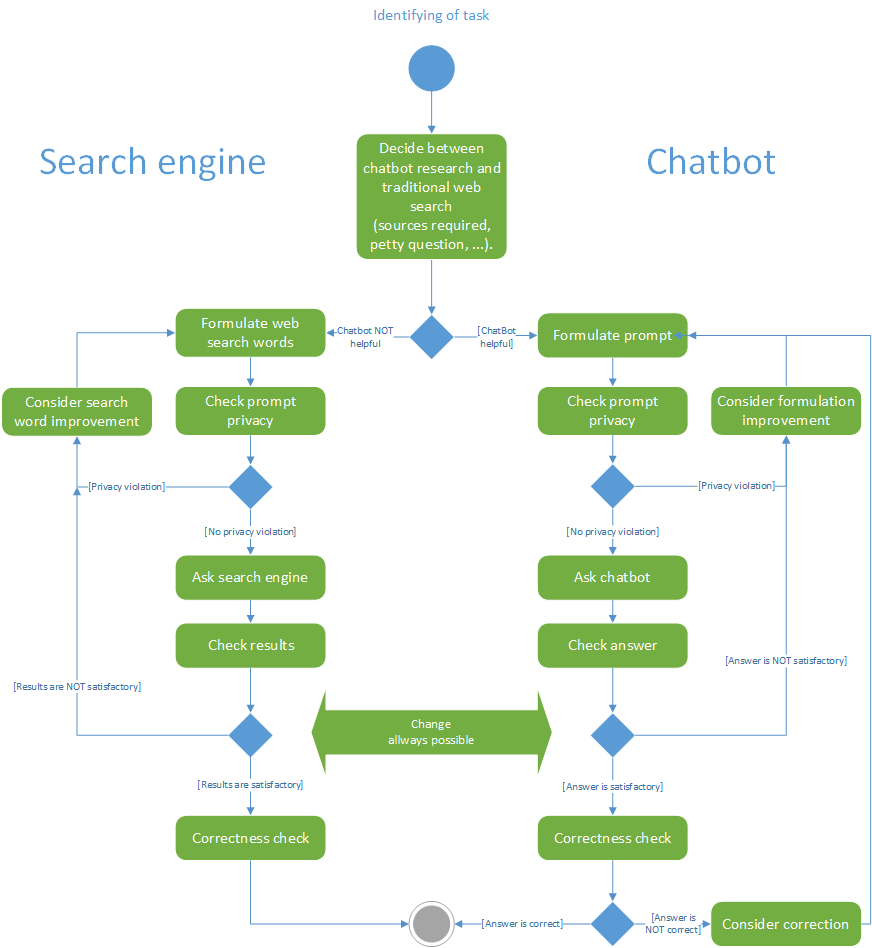
Comparison between traditional web search and chatbot research
There are fundamental similarities:
- Data and privacy protection must be taken into account.
- Meaningful information must be entered.
- Results must be read.
- Results must be checked for correctness.
- Unsatisfactory results require an adjustment of the input and repetition of the enquiry.
The complex similarities between the two methods show that our students not only need to learn the new chatbot research method, but also the old method. In my opinion, it's not just about chatbot usage skill, but rather about research competence in general.
Advantages of search engine and chatbot research
| Search Engine | Chatbot |
|---|---|
| Comprehensive and diverse media information from various sources, including websites, scientific articles, images, videos, books etc. | Questions are answered interactively and specific enquiries are responded individually. |
| A request has great scope and depth, allowing different perspectives to be explored with a wide range of sources. | Personalised answers can be well adapted to the level of learning and knowledge. |
| Results refer directly to sources so that these can be easily specified. |
Interactive dialogue can make the learning process more dynamic and motivating. |
| Independent research and information evaluation competences are developed by learning to identify and evaluate accurate and trustworthy sources. |
Support in formulating questions and interpreting answers can improve language skills. |
How to cite
Websites
The retrieval date is not required in the American Harvard or APA style: There are different citation rules. However, the general rule is that references for direct and indirect quotations should always be as complete and correct as possible, i.e. they should include (if known in detail) the author, year of publication, institution, exact location, etc. In the case of internet sources, the URL should be added.
For internet sources, the URL must be added.
In Germany, the date of the last retrieval of the source is generally required because websites can change in the meantime.
The retrieval date is not required in the American APA style: "Do not include a date of last review in a reference because content that has been reviewed has not necessarily been changed. [...]". (APA. Webpage on a Website References, 03 May 2024)
Chatbots
Unfortunately, the results of a chatbot are not verifiable for other readers and therefore do not stand up to any examination in the scientific sense. Therefore, the author of a text should first check whether chatbots are even authorised as a direct source or look for another source, e.g. a website.
Since there is no real person in a chatbot, the algorithm is cited as the author with an entry in the reference list and the corresponding in-text citation (APA. How to cite ChatGPT, 07 April 2023):
ChatGPT itself summarized its answer to the question: "Should ChatGPT be approved as a source of scientific articles?" summarized as follows: "In conclusion, while ChatGPT can be a valuable tool in the research and writing process, it should not be approved as a source of scientific articles in and of itself. It lacks the ability to verify information, undergo peer review, and ensure the credibility and reliability that are essential in scientific discourse." (OpenAI, 04 May 2024)
Learning situation
An exemplary learning situation could aim to apply both methods and experience the advantages and disadvantages:
Work order
Inform yourself in your working group about the dangers and safety regulations in [a professional activity that must be specified in more detail] by conducting research using a search engine AND a chatbot to check the respective results for accuracy and completeness.
This requires a precise comparison of the respective results.
Prepare a presentation of the security aspects with precise references and, if necessary, citations. You will be asked about this in the subsequent joint technical discussion. You should also be able to provide information about the advantages and disadvantages of these two research options. What opinion do you have about both research options?
Didactic justification
The focus remains on developing the competence to act professionally. The development of media skills or 'research skills' is part of this, but comes second and should not be an end in itself. Therefore, the security aspects are at the center of the presentation.
But in addition, oral and written native language skills should be improved as key competencies.
The lessons are carried out in an action-oriented manner, as described in the previous chapter: Solution: Performance assessment in the age of ChatGPT.
Learning objectives:
- Know, present and explain safety aspects of professional activities.
- Research with search engines and chatbots.
- Formulate search words or prompts.
- Check the accuracy and completeness of the respective information.
- Be able to cite and cite both types of sources.
- Know and describe the advantages and disadvantages of both methods and be able to choose the better method.
Note
The ability to write good prompts is a key skill when it comes to the sensible use of AI writing tools.
The option of giving chatbots a role specification for the answer is a frequently used tip: "Put yourself in the role of a specialist X and ..." (Wampfler, 2024)
Reference list:
American Psychological Association. (2024, May 03). Webpage on a Website References. https://apastyle.apa.org/style-grammar-guidelines/references/examples/webpage-website-references (Accessed: 03 May 2024)
American Psychological Association. (2024, May 03). How to cite ChatGPT. https://apastyle.apa.org/blog/how-to-cite-chatgpt. (Accessed 03 May 2024)
OpenAI. (2024). ChatGPT (Apr 29, 2024 version) [Large language model]. https://chat.openai.com
Wampfler, P. (March 2024): Feedback und Schreibunterstützung durch Sprach-KI. Pädagogik. 3/24. p19.