
"Has an" Association between school and school class
Completion requirements
A school has several school classes:
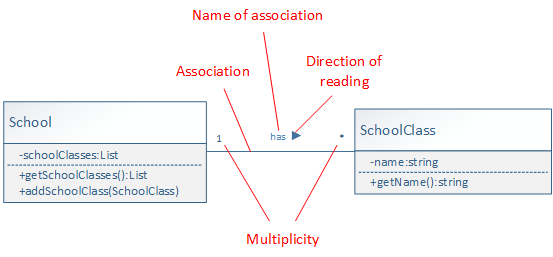
"Has an" association between School and SchoolClass
Notes:
- School needs a property of type List (or array) for holding more than one school class.
- School has a method
addSchoolClass()for adding further school classes.
This type of "Has an" association can be realized in Python as follows:
School.py
Contains two Class definitions:
1 2 3 4 5 6 7 8 9 10 11 12 13 14 15 16 17 18 19 |
# School.py class School: def __init__(self,schoolClasses): self.__schoolClasses = schoolClasses def getSchoolClasses(self): return self.__schoolClasses def addSchoolClass(self, schoolClass): # adds a school class self.__schoolClasses.append(schoolClass) class SchoolClass: def __init__(self,name): self.__name = name def getName(self): return self.__name |
testSchool.py
Demonstrates the use of the above defined classes:
1 2 3 4 5 6 7 8 9 10 11 12 13 | # testSchool.py from School import * # Import all from School.py school = School([]) # Creation of object school with empty list schoolClass = SchoolClass("c1") school.addSchoolClass(schoolClass) # adding of schoolclasses school.addSchoolClass(SchoolClass("c2")) schoolClasses = school.getSchoolClasses() # get list for sc in schoolClasses: # For loop iterates over list print(sc.getName()) |
In Python the For loop is used for iterating over a list.
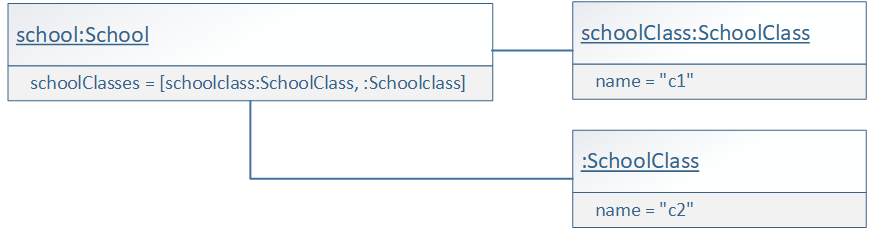
UML object diagram
Note: In this example the second object of class SchoolClass has no object name, because it was directly created while parameter passing. This kind of ownership is called composition. This object is owned exclusively in contrast to
the first object
schoolclass, which could be owned additionally by other objects (aggregation).
Last modified: Monday, 13 March 2023, 8:55 AM