
Integration of PyAD functionality into the program
School.py
For an initial export of the whole school with all school classes within their students the method addToLDAP() was added to class School. Also additionally a same named method addToLDAP() was added to class SchoolClass,
which is invoked by the first one. It creates a single school class in Active Directory.
Also the method SchoolClass.deleteFromLDAP() was added, which deletes a school class with students from the Active Directory:
1 2 3 4 5 6 7 8 9 10 11 12 13 14 15 16 17 18 19 20 21 22 23 24 25 26 27 28 29 30 31 32 33 34 35 36 37 38 39 40 41 42 43 44 45 46 47 48 49 50 51 52 53 54 55 56 | from Settings import Settings from Ldap import PyAD from CSV import Csv from User import Student class School: def __init__(self,schoolClasses): self.__schoolClasses = schoolClasses def getSchoolClasses(self): return self.__schoolClasses def addSchoolClass(self, schoolClass): self.__schoolClasses.append(schoolClass) def importStudentsFromCSV(self, filename): # import students of a certain csv file csv = Csv(filename) classNames = csv.importClassNames() # import names of school classes for className in classNames: schoolClass = SchoolClass(className,[]) listStudents = csv.importStudentsOfClass(className) # import student data of a certain name of school class for listStudent in listStudents: student = Student(listStudent[0],listStudent[1],listStudent[2],schoolClass) self.addSchoolClass(schoolClass) def addToLDAP(self): # initial export of whole school to Active Directory for schoolClass in self.__schoolClasses: schoolClass.addToLDAP() class SchoolClass: def __init__(self,name, students): self.__name = name self.__students = students def getName(self): return self.__name def getStudents(self): return self.__students def addStudent(self, student): self.__students.append(student) def addToLDAP(self): # export school class with students to Active Directory ldap = PyAD(Settings.dnStudents) ldap.createSchoolClass(self.__name) for student in self.__students: student.addToLDAP() def deleteFromLDAP(self): # delete school class with students from Active Directory ldap = PyAD(Settings.dnStudents) for student in self.__students: student.deleteFromLDAP() ldap.deleteSchoolClass(self.__name) |
User.py
The class Student have got both methods addToLDAP() and deleteFromLDAP(), which are called from the same named methods of class SchoolClass:
1 2 3 4 5 6 7 8 9 10 11 12 13 14 15 16 17 18 19 20 21 22 23 24 25 26 27 28 29 30 31 32 33 34 35 36 37 38 39 40 41 42 43 44 45 46 47 48 49 |
from Settings import Settings from Ldap import PyAD class User: # superclass "User" def __init__(self, surname, firstname, dateOfBirth): self._surname = surname self._firstname = firstname self._password = firstname[0] + surname[0] + dateOfBirth self._dateOfBirth = dateOfBirth self._username = surname def getSurname(self): return self._surname def getFirstname(self): return self._firstname def getPassword(self): return self._password def getDateOfBirth(self): return self._DateOfBirth def getUsername(self): return self._username class Student(User): # subclass "Student" def __init__(self, surname, firstname, dateOfBirth, schoolClass): User.__init__(self, surname, firstname, dateOfBirth) schoolClass.addStudent(self); self.__schoolClass = schoolClass def getSchoolClass(self): return self.__schoolClass def addToLDAP(self): # adds student to ldap ldap = PyAD(Settings.dnStudents) # ldap.createStudent() returns the possibly modified username for updating self._username = ldap.createStudent(self._username , self._surname , self._firstname , self._password , self._dateOfBirth , self.__schoolClass.getName()) def deleteFromLDAP(self): # remove student from ldap ldap = PyAD(Settings.dnStudents) ldap.deleteStudent(self._surname, self._firstname, self._dateOfBirth, self.__schoolClass.getName()) |
Ldap.py and Settings.py are unchanged and were alread described in Solutions: Improvements of class PyAD.
testPyAD.py
The above defined functionality is used with the following code:
1 2 3 4 5 6 7 8 9 10 11 |
from School import * # import classes from User import * school = School([]) schoolClass = SchoolClass("school_class1",[]) student1 = Student("Miller", "Sam", "11.11.2000", schoolClass) student2 = Student("Miller", "Paula", "10.10.2001", schoolClass) school.addSchoolClass(schoolClass) school.addToLDAP() # exports whole school to AD # schoolClass.deleteFromLDAP() # deletes school class from AD |
The result on AD is:
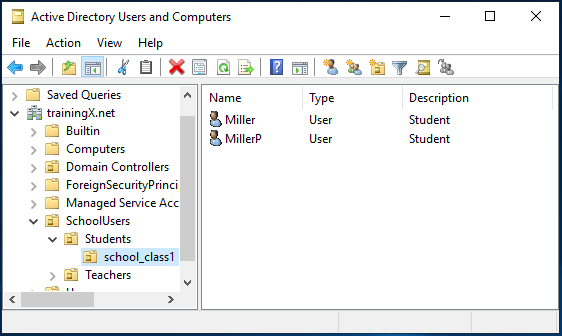
Two new students in AD
Finally a look at the UML sequence diagram again:
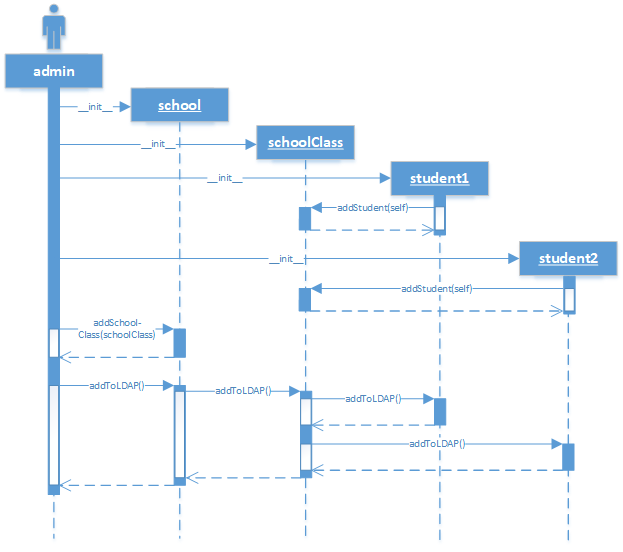
UML sequence diagram of adding students to AD
This programme now forms the basis for action-oriented assignments, because the students' competences should now be developed.