
Principles of Artificial Intelligence
Artificial intelligence (AI) is a field within computer science focused on automating intelligent behavior, which includes machine learning. (The term is used despite ongoing controversies surrounding the definitions of intelligence.)
Knowledge-based AI or rule-based AI
Traditional programming
AI can be implemented in a traditional manner by constructing a sequence of if-then statements and employing simple control structures or rules. These systems, known as "expert systems," find applications in tasks like disease diagnosis based on symptoms. While AI can be achieved to some extent through conventional programming, the complexity of algorithms may increase significantly depending on the specific requirements.
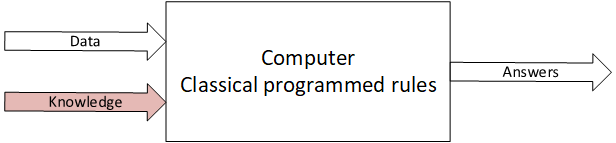
Knowledge-based or rule-based AI
Data-based AI
Machine learning
In Machine Learning, on the other hand, a machine learns these rules automatically by being trained on a collection of known examples. Machine learning is the most common method of achieving artificial intelligence today.
This so-called data-based AI, also known as data-driven AI, relies on large data sets to learn, make decisions and solve problems. In data-based AI, specific algorithms are not programmed directly, but these algorithms are learnt by a Artificial Neural Network ANN using large amounts of data to recognise patterns, relationships and trends. The learning or training process involves recognising and generalising data so that the AI system can make predictions, classifications or generate knowledge.
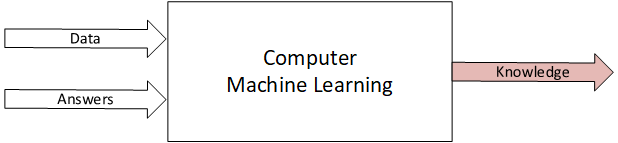
Data-based AI
Deep learning
Deep learning is a special form of machine learning in which artificial neuronal networks ANN (programmatic replicas of networked brain cells, so-called neurons) are trained with data and compared with the expected results. The (neural) connections between the neurons are weighted differently or reinforced (bias). "Deep" means that the ANN is "deep", meaning that it has many "hidden layers" and therefore it has a certain complexity:
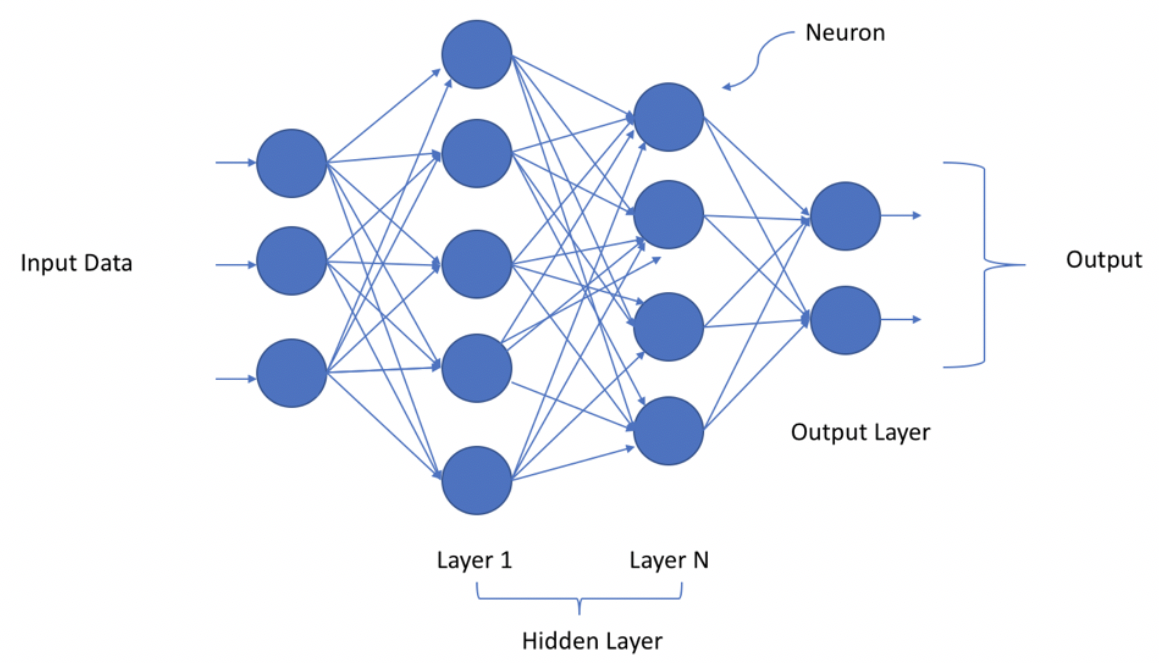
Artificial Neural Network - ANN
Deep learning is therefore a sub-area of machine learning, which in turn is a sub-area of artificial intelligence:
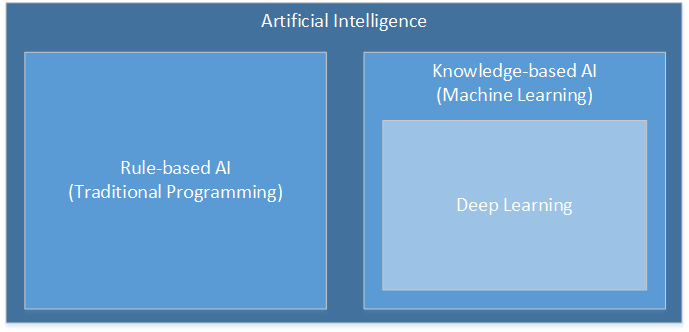
Relationship between artificial intelligence, machine learning and deep learning